
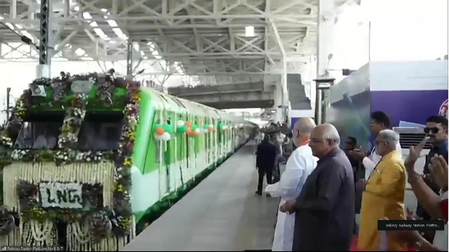
Dual-fuel technology can replace up to 40 per cent of diesel use and is aimed at cutting fuel costs and emissions
Ahmedabad, Sept 2026 : India’s first liquefied natural gas (LNG)-powered train was flagged off from Sabarmati on Sunday by Union Home and Cooperation Minister Amit Shah and Gujarat Chief Minister Bhupendra Patel, marking a significant step towards introducing alternative fuels in railway operations
The initiative seeks to reduce the Railways’ dependence on conventional diesel and explore the use of cleaner alternative fuels while maintaining the operational capabilities of diesel-powered trains
The train operates on a diesel-plus-LNG dual-fuel system developed for its Driving Power Cars (DPCs). Two 1,400-horsepower DPCs based at the Sabarmati Integrated Coaching Depot have been converted to run on both LNG and diesel
The converted power cars have already completed more than 2,000 km of field trials to assess the performance, reliability and operational viability of the technology under actual working conditions
According to trial data released by the Railways, the dual-fuel system can substitute up to around 40 per cent of diesel consumption with LNG. The technology is expected to reduce fuel expenditure while also lowering emissions, including carbon dioxide, nitrogen oxides and particulate matter
Earlier railway assessments estimated that the use of the technology could generate annual fuel savings of around Rs 11.9 lakh for a single DPC. For an eight-coach rake, the estimated annual savings were around Rs 23.9 lakh
The dual-fuel arrangement also provides operational flexibility by allowing the engine to switch between LNG and diesel depending on fuel availability. The system has been designed to retain the power and operating performance of conventional diesel engines while enabling partial replacement of diesel with LNG
Each converted DPC is equipped with an LNG tank with a capacity of approximately 2,200 litres. The tanks can hold around 850-900 kg of usable LNG. A full LNG load is expected to support approximately 1,600 km of operation, reducing the frequency of refuelling



टिप्पणियाँ 0