
Union Minister of State (Independent Charge) for Science & Technology and Earth Sciences and MoS PMO, Personnel, Public Grievances, Pensions, Atomic Energy and…
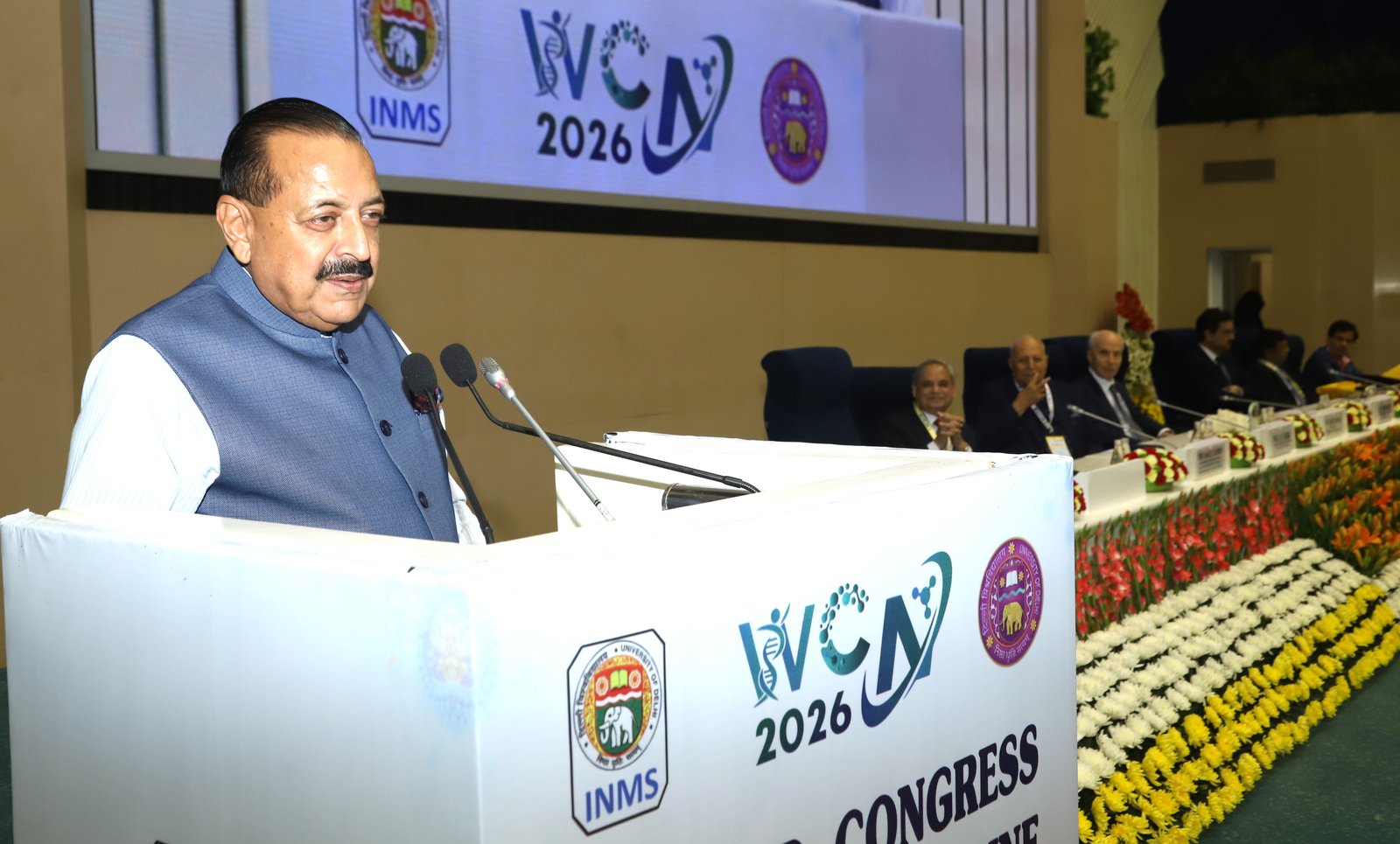
Union Minister of State (Independent Charge) for Science & Technology and Earth Sciences and MoS PMO, Personnel, Public Grievances, Pensions, Atomic Energy and Space, Dr Jitendra Singh today said that Nanomedicine will drive the next generation of precision Medicine and personalised Healthcare, adding that India's indigenous research carries global potential
Speaking at the inaugural function of the World Congress on Nanomedicine 2026 at Vigyan Bhawan, New Delhi, Dr. Jitendra Singh described nanomedicine as one of the most transformative developments in medical practice, with the potential to make healthcare increasingly precise and personalised by working at the nanometre scale. He said the future of medicine would increasingly involve individualised treatment based on a patient’s genetic profile, lifestyle, dietary habits and environmental factors, with nanotechnology offering new possibilities for precision at the cellular level
The World Congress on Nanomedicine 2026, hosted by the Institute of Nano Medical Sciences (INMS), Faculty of Medical Sciences, University of Delhi, is bringing together over 2,000 participants, including eminent scientists and young researchers, to discuss emerging advances and applications in nanomedicine. Nobel Laureate Prof. Roger D. Kornberg, Nobel Laureate and Stanford University, USA, is the Chairperson of the Congress, while Prof. T.M.S. Chang, McGill University, Canada, is the Honorary President. Prof. Yogesh Singh, Vice-Chancellor, University of Delhi; Prof. G.P. Talwar; Prof. Gobardhan Das, Member, NITI Aayog; Prof. Ramesh Chandra; and Prof. Indrajit Roy were among the distinguished participants present at the inaugural session
Dr. Jitendra Singh explained that nanomedicine involves the application of nanotechnology in medicine, working with structures at the scale of one-billionth of a metre. He said that as medicine moves towards precision healthcare, patients suffering from the same disease may increasingly require different treatment approaches depending on their genetic profile, lifestyle, dietary habits and environmental factors. Nanotechnology, by enabling interventions at the cellular level, can play an important role in making such treatment more precise
The Minister said nanomedicine will also have significance beyond healthcare, with its applications expected to influence the cost-effectiveness of health processes and contribute to the wider economy. He referred to the growing global interest in nanomedicine as an indication of the scale of opportunity emerging in this field
Dr. Jitendra Singh also cautioned against excessive dependence on technology in medical practice. He said that while technologies such as Artificial Intelligence and nanotechnology are opening new possibilities, they must complement the clinical sense of doctors rather than compromise it. The challenge, he said, is to synergise advanced technology with the human and clinical dimensions of medicine
Calling for reinventing medical teaching in response to rapid technological changes, Dr. Jitendra Singh recalled that medical education traditionally placed strong emphasis on diagnosing patients through careful observation and physical examination. He said these foundational clinical skills should continue to remain relevant even as technological tools become increasingly sophisticated
Giving details of the Government’s support for nanomedicine research, Dr. Jitendra Singh said the Department of Biotechnology is supporting 210 R&D projects in nanomedicine with financial support of ₹174 crore. The projects cover targeted drug delivery, cancer nanomedicine, infectious-disease nanomedicine, nucleic-acid and vaccine delivery, nano-diagnostics and imaging, regenerative medicine and wound healing, as well as nanotoxicology and regulatory science
Among the promising research areas, the Minister referred to oral insulin nanoparticles and nanobots for breast cancer, besides precision nanoinjection and targeted breast cancer nanomedicine. He recalled that earlier efforts towards oral insulin faced challenges related to absorption and digestive enzymes, and said advances in nanotechnology could provide new possibilities for addressing such challenges


टिप्पणियाँ 0